

“Is This How American Democracy is Supposed to Work?”
-Assoc. Justice Elena Kagan in Rucho v. Common Cause
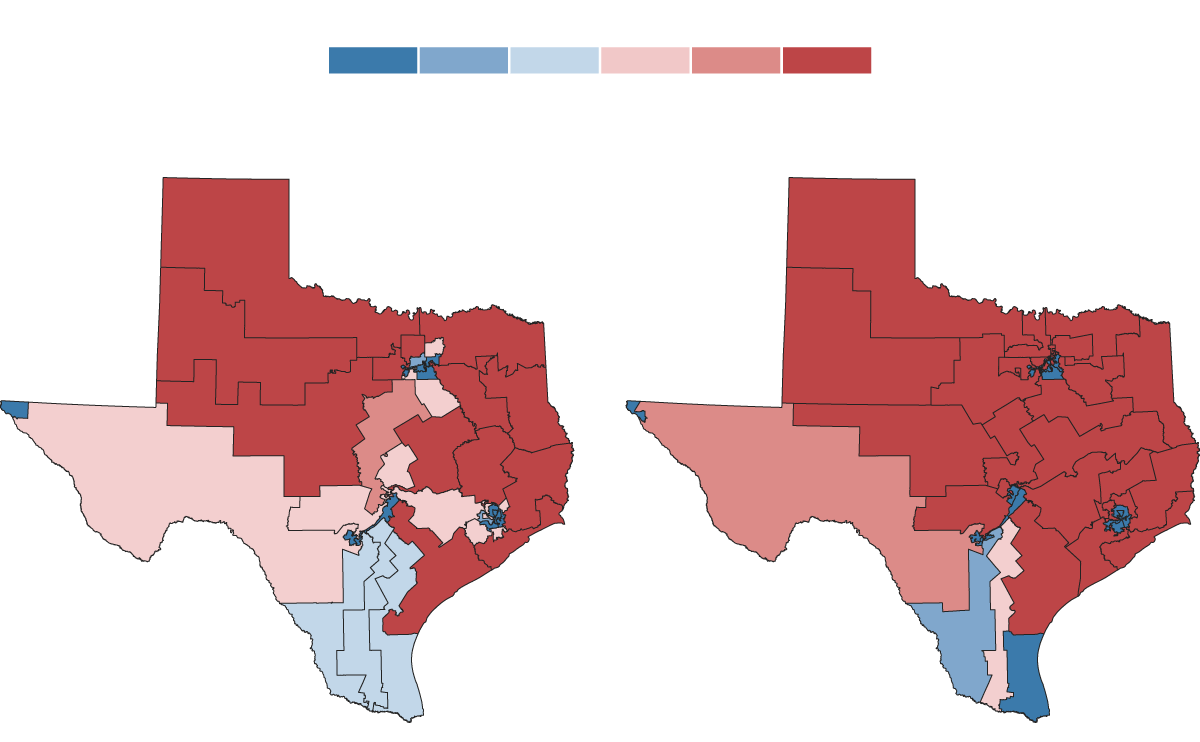
Last week the Republican-controlled Texas legislature prepared to hold a vote on its latest redistricting map. The map is more accurately described as a re-redistricting, undertaken in a special session with the express intention of increasing the number of Republican controlled Congressional districts. Democratic lawmakers who are in the minority and whose districts have been targeted for destructive gerrymandering have left the state in order to deny a quorum and halt the legislative process that would have resulted in the adoption of the new gerrymandered districts. That the districts of Black lawmakers several of whom, like Rep. Jasmine Crockett and Rep. Al Green, have been particularly effective and relentless critics of President Trump and their Republican colleagues, has thrown the conflict into even sharper focus.
Redistricting is the process of allocating the population into geographic districts for purposes of political representation. Congressional districts are reallocated every ten years after the release of population numbers from our decennial census, per our Constitution. Texas had already completed its redistricting cycle for 2020.
But last month President Trump began to see the writing on the wall. His approval ratings reached their lowest levels for the first six months of his presidency.[i] Despite all of the thumbs up and back-slapping that accompanied the passage of Trump’s omnibus “Big, Beautiful Bill,” Trump is keenly aware that much of the bill is hugely unpopular[ii] and is likely to get more unpopular as his MAGA constituents enter the “find out” phase of their unquestioning support for his sweeping agenda.
Without a submissive Congress, Trumps’s agenda would have died on the vine. His signature initiatives – gutting federal government agencies, starving disfavored programs of funds, expanding ICE and the Department of Homeland Security, absorbing the Dept of Justice into the White House and using its powers for his own political agenda, blackmailing universities with the threat of withholding federal money, dismantling aid programs both domestically and abroad - would not have been possible without the acquiescence of the Republican-controlled Congress which has turned over its constitutional tariff and appropriations power to the President.
If Democrats win control of the House in 2026, they will helm the key committees that under Republican control have acted as clients of the President. That means appropriations discipline, oversight, investigations and the potential for impeachment will all be in the hands of Democrats. Trump desperately needs a loyal minion like Rep. Mike Johnson (R-LA) to remain in the Speaker’s chair. And so Trump set about finding ways to fix the game. On July 15th Trump made clear what he needs. With trademark bluntness he publicly demanded that the Texas legislature redistrict their congressional map to gain five additional Republican-controlled seats.[iii]
We should pause here a moment, because Trump’s demand. The President of the United States has no authority or right to dictate how state legislatures draw congressional maps. To do so is to interfere with the sovereignty of state legislatures in the exercise of one of its most important functions. We must not become so inured to Trump’s bold excesses that we fail to recognize the thuggish overreach and anti-constitutional nature of his demand.
But while it is tempting to focus solely on Trump’s power grab, and even on the perfidy and dastardly conduct of Republican leaders in Texas, we should not forget the heavy hand of the conservative majority on the Supreme Court in creating the context in which this latest abuse of political power can happen. Democrats, who are facing criticism for even considering engaging in retaliatory gerrymandering in blue states, would do well to remember how we got here.
Last month I suggested that the problem with the conservative majority on the Supreme Court is that they lack the range[iv] to grapple with the challenges presented by the kind of disputes, conflicts, and complex questions that make their way to the Court in the 21st century. The mere fact that the majority has adopted a theory of decision-making that evaluates the unique and unanticipated disputes of the 21st century through the lens of how such disputes would have been understood centuries ago, demonstrates how ill-equipped the conservatives on the current Court are to tackle the complexity of the issues of this constitutional moment. To decide that the meaning of law is fixed forever in amber, bound in meaning to the circumstances and thinking of men from four centuries ago, is to abdicate the demands of the modern judicial decision-making function.
But abdication of that responsibility is something we have seen with some regularity from the Court’s conservative majority. Partisan gerrymandering presents a textbook example. In 2018 in Rucho v. Common Cause,[v] the Court decided that it could not adjudicate a claim raising the unconstitutionality of extreme partisan gerrymanders by Democrats in Maryland, and Republicans in North Carolina. The bipartisan nature of the conduct made it a particularly effective vehicle for the Supreme Court to end the partisan excesses in gerrymandering that have increasingly diminished the power of voters to meaningfully decide on the political leadership of our country.
Nevertheless, even as the conservative majority on the Court conceded that “such gerrymandering is ‘incompatible with democratic principles,’”[vi] the justices insisted that the Court was powerless to provide a remedy, insisting that there are no “objective measures” or standards by which courts can evaluate and impose remedies for such claims.
This was untrue on its face. Credible and effective measures for evaluating “how much is too much” partisan gerrymandering were presented to the Court by the parties - methods recounted and reviewed carefully in the dissenting opinion of Justice Kagan. Lower federal courts had also embraced standards for evaluating partisan gerrymandering claims. Still, the majority punted.
Justice Kagan offered a raw assessment of the majority’s abdication of its responsibility in the starkest terms:
So the only way to understand the majority’s opinion is as follows: In the face of grievous harm to democratic governance and flagrant infringements on individuals’ rights – in the face of escalating partisan manipulation whose compatibility with this Nation’s values and law no one defends – the majority declines to provide any remedy. For the first time in this Nation’s history, the majority declares that it can do nothing about an acknowledged constitutional violation because it has searched high and low and cannot find a workable legal standard to apply.
Today we live with the majority’s abdication of its responsibility. The ugliness unfolding in Texas – indeed President Trump’s open and shameless demand that a state legislature convene an emergency legislative session and gerrymander congressional districts for the express purpose of guaranteeing Republican control of the House of Representatives – are directly related to the SCOTUS majority’s refusal to remedy an unconstitutional practice that threatens the integrity of democracy in our country. The President and the Texas state legislature engage in their actions so openly with full confidence that no court claim of partisan gerrymandering can stop them (although they are likely to face a racial gerrymandering claim).[vii]
The SCOTUS majority’s feigned posture of judicial humility in Rucho – its insistence that to remedy extreme partisan gerrymandering would constitute “an unprecedented expansion of judicial power” - is belied by other recent cases in which the Court showed no hesitation in exercising muscular power in dictating terms of fairness in the rules that go to the heart of American political life.
In just the past 15 years the Court has: limited the power of federal district courts to block patently unconstitutional actions nationwide (Trump v. Casa);[viii] immunized the President from criminal acts committed while serving in office (Trump v. United States);[ix] subverted the power of Section 3 of the 14th Amendment that prohibits insurrectionists from holding elected office (Trump v. Anderson);[x] held that there is no judicial remedy for extreme partisan gerrymandering (Rucho); weakened federal laws against public corruption (Snyder v. United States);[xi] struck down the most powerful and consequential provision of the Voting Rights Act (Shelby County v. Holder);[xii] and struck down campaign finance laws meant to contain corporate ownership of federal elections (Citizens United vs. FEC).[xiii] It is stunning.
With so many guardrails smashed by this Court, is it any wonder that our political processes are careening over a cliff?
Now Democratic governors and party leaders are left to decide whether to counter the shameful actions of the Republicans by convening their own sessions to redistrict in blue states like Maryland, New York and California, to pick up additional Democratic-controlled congressional districts. For some, it presents an ethical dilemma: should Democrats fight Republican redistricting shenanigans with their own?
The stakes are unimaginably high. If Democrats cannot win the House in the 2026 elections, there will be likely no chance to hold on to the remnants of our democracy that are dangling by a thread in the wake of Trump’s authoritarian assault.
That officials in Texas so willingly bowed the knee to Trump’s demand is of course shameful. They should be roundly condemned. But, as with so many other abuses of power that we have found ourselves unable to rein in, the Supreme Court has played an important role in weakening or removing the tools we need to protect against political excesses that threaten our democracy.
As Democrats make their decisions they would do well to remember that they are playing the hand dealt to them by the Supreme Court -- especially in Rucho - the last best chance for the Court to rein in the extreme partisan gerrymandering that has resulted in the distortion of power in American politics. Whatever Democrats are now compelled to do in a desperate effort to save our democracy should be understood within that context. This is the house the Supreme Court built. And it is burning.
There are many factors that have contributed to this perilous political moment in our nation. But we must not forget the role of the Supreme Court in disabling our ability to protect our democracy against those who would destroy it from within.
[i] https://www.reuters.com/world/us/trump-approval-rating-sinks-40-lowest-his-term-reutersipsos-poll-finds-2025-07-29/
[ii] https://www.politico.com/news/2025/07/16/trump-law-new-poll-00455878
[iii] https://www.washingtonpost.com/video/politics/trump-wants-5-new-house-seats-in-texas/2025/07/15/b2716db4-348d-4e98-b6d6-36ef8937019d_video.html
[iv] https://sherrilyn.substack.com/p/a-court-without-the-range
[v] 588 U.S. 684 (2019) https://supreme.justia.com/cases/federal/us/588/18-422/
[vi]Id., at, citing Arizona State Legislature v. Arizona Independent Redistricting Commission, 576 U.S. 787 (2015)
[vii] This is at least true for partisan gerrymandering. The racial implications of the Republicans’ gerrymander will most certainly provoke a constitutional challenge on the grounds of racial gerrymandering.
The Court has not yet deemed racial gerrymanders beyond its ability to remedy. But just last week the Court issued an order indicating that it will consider whether racial gerrymanders can be challenged under Section 2 of the Voting Rights Act, potentially preparing to remove a tool from voting rights advocates that has been essential to challenging racist redistricting practices for 50 years. https://www.supremecourt.gov/orders/courtorders/080125zr_i4dk.pdf
[viii] https://www.supremecourt.gov/opinions/24pdf/24a884_new2_0pl1.pdf
[ix] https://supreme.justia.com/cases/federal/us/603/23-939/
[x] https://supreme.justia.com/cases/federal/us/601/23-719/
[xi] https://www.law.cornell.edu/supremecourt/text/23-108
[xii] 570 U.S. 529 (2013) https://www.law.cornell.edu/supremecourt/text/23-108
[xiii] 558 U.S. 310 (2010) https://supreme.justia.com/cases/federal/us/558/310/ .
Brilliant analysis and illumination of the perverse, anti-democratic actions of the US Supreme Court’s MAGA majority, Republicans in Congress, and red state legislatures foisting their unpopular intolerance and hatred on people who expect them to honor the Constitution and our laws. 🤯🥺
Yet another excellent analysis! Thank you for the reminder about how SCOTUS put us here!