
The Critical Connection Between Brown v. Board and Voting Rights
There Is a Reason That Dr. King Gave his Famous "Give Us the Ballot" Speech on the Third Anniversary of Brown v. Board of Education

Today marks the 72nd anniversary of the Supreme Court’s decision in Brown v. Board of Education , the case litigated and developed and tried by a group of brilliant Black lawyers at the NAACP Legal Defense Fund. In that decision the Supreme Court finally overturned Plessy v. Ferguson, the 1896 decision in which the Court deemed Jim Crow segregation laws constitutional and transformed the direction of our country in the 20th century. Deeming state-compelled racial segregation unconstitutional, the Court’s decision constituted the beginning of the end of the Jim Crow system that rendered Black people second-class citizens, whose citizenship was proscribed by the boundaries set by whites.
Brown, and the courageous activism of ordinary Black people during the Civil Rights Movement that followed finally freed the 14th Amendment from the shackles that had bound its promise since the post-Reconstruction period. At least formally. Because resistance to Brown was strong, relentless, and often violent. Defiance in the face of Brown was so brazen that Brown’s opponents openly called their effort "Massive Resistance." Over one hundred members of Congress signed the Southern Manifesto, vowing to resist Brown using any legal means available.
Many of the constituents of those Congress members chose intimidation, threats, assault, and murder as their means of resisting the end of Jim Crow. They were most often rewarded with impunity by their neighbors and by the tacit support and approval from the leaders in their communities, who did their part through the more “respectable” White Citizens' Councils.
Black people needed power. This is why Black southerners were so laser-focused on the vote. They had the numbers. Black residents outnumbered their white counterparts in counties throughout the south. The ability to elect candidates of their choice to public office would, Black people believed, change the political calculus and create the conditions in which Jim Crow would fall. In other words, they knew that white supremacist control could only be contained when Black voters held a measure of political power.
That is why on the third anniversary of Brown on May 17, 1957, in the face of ongoing recalcitrance to school integration by southern whites, civil rights leaders called for a “Prayer Pilgrimage” to meet on the steps of the Lincoln Memorial. There, Black civil rights and faith leaders, advocates, and elected officials demanded compliance with Brown and rallied in favor of Black voting rights. The Rev. Dr. Martin Luther King, Jr., fresh from his emergence on the national stage leading the Montgomery Bus Boycott campaign, gave his first national speech at the Pilgrimage. The name of the speech he delivered that day was “Give Us The Ballot.”


King and tens of millions of Black people believed that the vote, and the political power that would come along with it, would allow Black communities to shape their own destiny, transform their communities and the material conditions of their lives, and would empower Black people to politically compel compliance with Brown.
In stirring and repeated demand King intoned, “Give Us the Ballot!” King’s words ring out today, reminding us of the faith that Black people have long believed the vote holds for the protection of our citizenship and dignity:
But even more, all types of conniving methods are still being used to prevent Negroes from becoming registered voters. The denial of this sacred right is a tragic betrayal of the highest mandates of our democratic tradition. And so our most urgent request to the president of the United States and every member of Congress is to give us the right to vote.
Give us the ballot, and we will no longer have to worry the federal government about our basic rights.
Give us the ballot (Yes), and we will no longer plead to the federal government for passage of an anti-lynching law; we will by the power of our vote write the law on the statute books of the South (All right) and bring an end to the dastardly acts of the hooded perpetrators of violence.
Give us the ballot, and we will transform the salient misdeeds of bloodthirsty mobs into the calculated good deeds of orderly citizens.
Give us the ballot, and we will fill our legislative halls with men of goodwill and send to the sacred halls of Congress men who will not sign a “Southern Manifesto” because of their devotion to the manifesto of justice.
Give us the ballot, and we will place judges on the benches of the South who will do justly and love mercy, and we will place at the head of the southern states governors who will, who have felt not only the tang of the human, but the glow of the Divine.
Rev. Dr. Martin Luther King, Jr. "Give Us The Ballot." May 17, 1957.
It was not until the passage of the Voting Rights Act eight years later, that Black people across the country would have meaningful access to the ballot. In the first 15 years after the Act’s passage, Black voter registration and participation increased and the number of Black elected officials in the country rose dramatically
It was through Brown and the Voting Rights Act that democracy came to this country. It was bought with the sacrifice and blood of countless activists and ordinary people. This country has never fully acknowledged the debt it owes those Americans whose courage and determination ultimately released this country from the shame and dishonor of legal apartheid and allowed the U.S. to credibly make its claim to democratic integrity on the world stage during the fraught days of the Cold War.
Sixty-one years later – just two weeks ago --in an act of perverse constitutional misinterpretation, the Supreme Court held that the 14th Amendment – the core Reconstruction Amendment designed to protect the full and first-class citizenship of Black people - prevents legislatures from protecting the ability of Black voters to elect candidates of their choice in racially gerrymandered congressional districts. Racial gerrymandering may exist. It may even be anti-democratic. But in Louisiana v. Callais the Court deployed a version of colorblindness – which the conservative majority on the Court has deemed an imperative of the 14th Amendment (a non-textual and ahistorical reading of the Amendment) to render racial gerrymandering a problem without a remedy, according to the majority’s reasoning.
In other words, to use race to remedy racism, is itself racist. Or as the Chief Justice said elsewhere years ago (and I’m paraphrasing liberally), the only way to fix racism is to pretend that racism doesn’t exist.1
Almost immediately Republican-controlled state legislatures and Governors throughout the South called legislative sessions to redistrict their congressional districts to reduce or eliminate congressional districts that allow Black people to elect their candidates of choice to the House of Representatives. This will ensure greater power for Republicans in Congress.
The white supremacist of the Republican effort was revealed last week when Mississippi Gov. Tate Reeves called for redistricting to end the “reign of terror” of Black Congressman Bennie Thompson, one of Mississippi’s four member2 House delegation. The population of Mississippi is nearly 40% Black – the highest of any state in the country. Mississippi has not elected a statewide officer who is Black since Reconstruction.
But Gov. Reeves deems the mere presence of one member of the four-member congressional delegation sufficiently powerful as able to conduct a “reign of terror” in the state. A core tenet of white supremacy is that merely to share power with Black people is losing, and that Black political participation – no matter how modest – is takeover.
What sane-thinking Americans must now understand is that to eliminate Black political power is to not only consign Black people to second-class citizenship across the South where most Black people live, it will also usher in the end of democracy in this country. It will catapult us back to the 1950s, with all of the ignominy of functioning as a half- apartheid state as part of our national identity once again. And they won’t stop at the South.
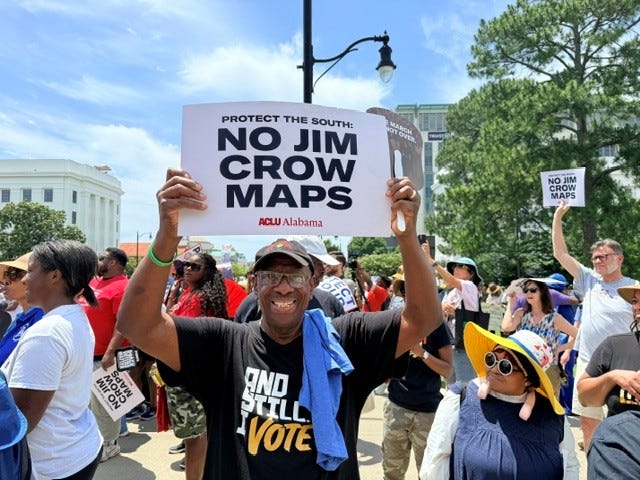
That is why it was gratifying to be part of the thousands who gathered in Selma and Montgomery, Alabama on Saturday in an act of solidarity and the shared purpose. I understand from the organizers that this gathering was only the first, and that they will plan similar mobilization efforts in other southern state capitols where legislatures are engaged in eliminating Black political representation in their states.
The energy in Selma and Montgomery was infectious. As these gatherings continue, and as organizers home in on registration, mobilization, turnout and protest, find your way to be a part of these efforts. The chances of turning this around are slim, but we can’t win if we don’t fight.
See e.g., https://www.npr.org/sections/codeswitch/2014/04/23/306173835/two-justices-debate-the-doctrine-of-colorblindness.
An earlier version of this piece mistakenly referred to Mississippi’s “five member” House delegation. Mississippi holds four seats in the U.S. House of Representatives.
Thank you for the historical perspective.
Everyone must vote in all elections.Focus on LOCAL (*mayor/city council, school board, etc); STATE (*Governor,Lt governor,Secretary of State, state senators/representatives, etc);Federal (Congressional representatives/US Senators,*POTUS/VicePOTUS).We must stay vigilant, keep informed, spread the truth, vote, assist with registration, donate, march, and stay in 'good trouble.'All hands on deck are needed to promote the John Louis Bill/address SCOTUS-increase to 13/ethics/statehood of Puerto Rico & Washington DC; form allegiances with other minorities